Disematostoma minor
You may also like



Page 1 of 4
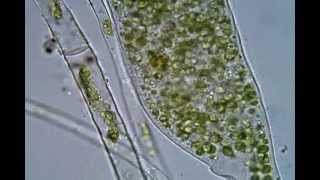
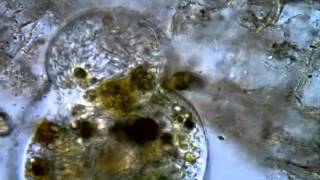
Disematostoma swims very quickly and erratically, often gyrating laterally and spiralling forward at the same time. It looks very similar to its cousin Frontonia, but can be distinguished its oral apparatus, which carries a fairly large paroral membrane on the right, and by its long, curved macronucleus. To get a better look at the nucleus, I slipped a bit of methylene blue into the water. The similar species Disematostoma buetschli is normally somewhat larger than these specimens, and usually carries symbiotic algae (zoochlorellae). Kahl describes a smaller species, otherwise identical to D. buetschli, under the name D. minor. The size range of the ciliates in my sample (88 to 113 um) is a little higher than the size Kahl gives for D. minor.
